
Coaches have a character arc… Player > Coach > Person!
Some coaches never change, while others seek out development opportunities. Some go through tough times that naturally force change, while others actively invite discomfort, knowing they’ll reap the benefits in the long run.
I believe the best coaches go through three stages. Each comes with its own challenges, but ultimately, they arrive at a place where they can coach with genuine personality—without masks or bravado. Eventually, they cut out the bullshit!
Stage One: Player Mode
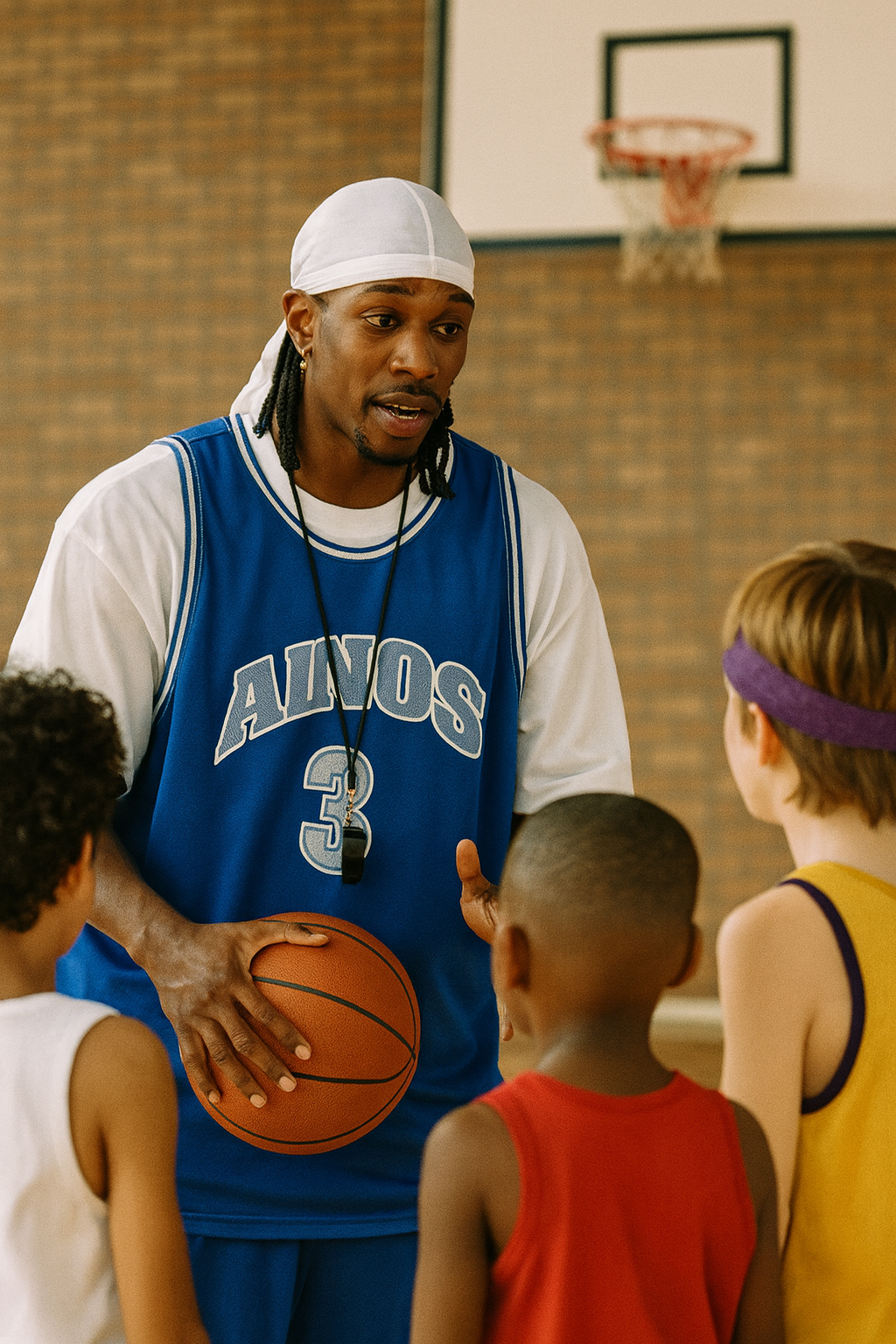
I think this is where we all start. I don’t mean we were all pro players, but we each bring a view of the game that’s shaped by personal experience—often quite different from that of traditional coaches. Maybe you grew up playing 2K and know every NBA player inside out. Maybe you were a local league player with hoop dreams, a could-have-been who finally gave up the ghost, or just someone who liked watching American sports, Rocawear, and Wu-Tang. (Yes, I’m getting old!)
Either way, you came into coaching with a perspective heavily influenced by how you once perceived the game.
I’ve seen many former players struggle to shake off the influence—both good and bad—of their own playing experience. These coaches often live and die by the time-honoured session plan: dynamic stretch, layup lines, shell drill, 5v5, killer. Their playbook hasn’t changed since the key was a different shape and the ball was square. It’s a comfortable space to operate in, and they’re rarely called out for lacking a contemporary approach—because they always have the loaded bullet: “That’s how we did it in my day, and it worked for me!”
The pros:
Kids can be inspired. You might still hit shots in practice. You might even have an old video tape of that 25-point game you once had. Parents see someone who “knows what it takes” guiding their child through the early stages of development.
The cons:
People change. Kids change. The game changes. And whether we like it or not, society changes too. What was acceptable then is often no longer acceptable now. Run suicides after practice, and eventually safeguarding might be in touch. Berate players from the sideline, and someone will flag it as unacceptable. If you’re not winning, those challenges come quicker and louder.
“Beware the coach whose calling card is their playing career!”
Stage Two: “Yes, Coach!”
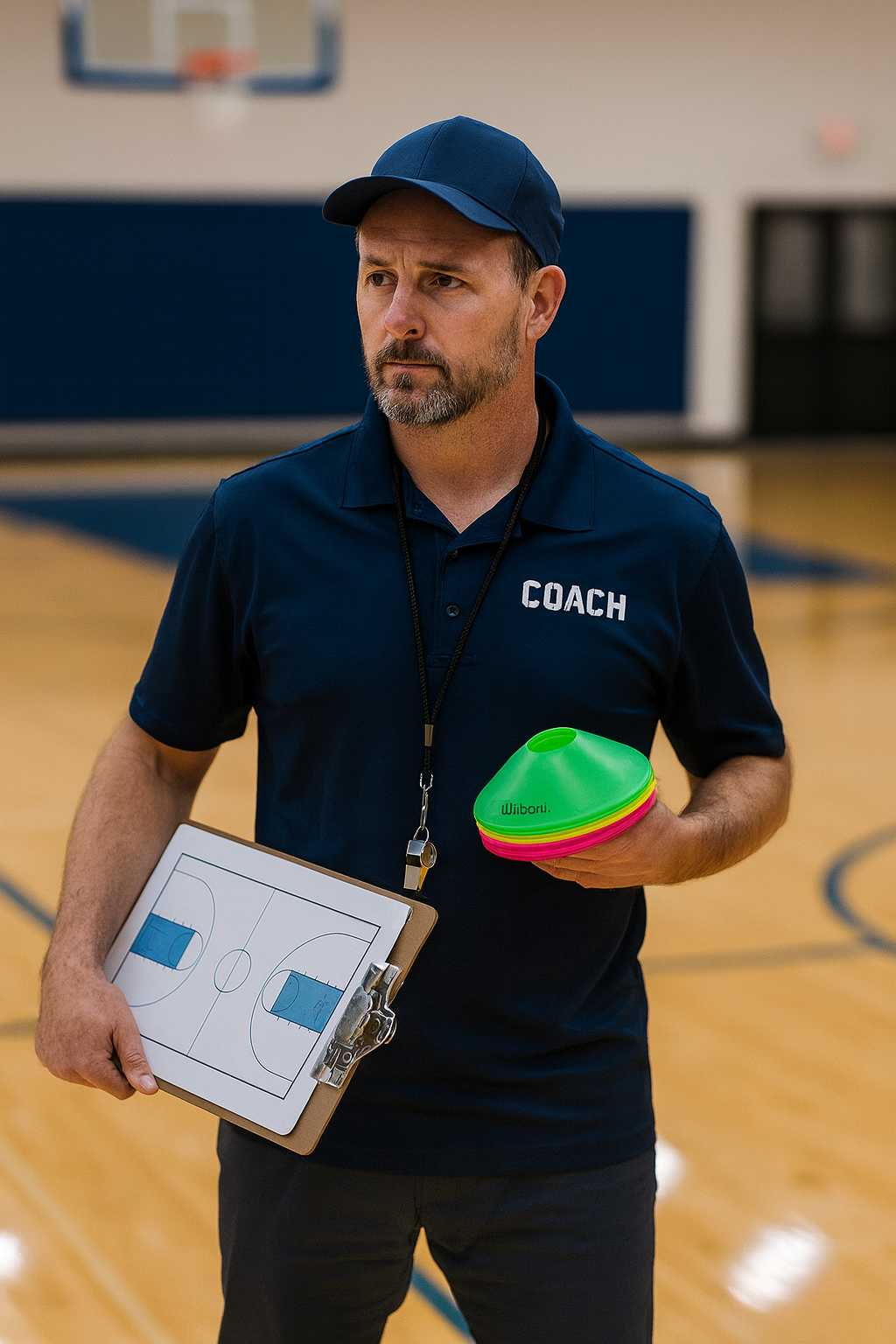
I was stuck here for a long time. Wearing a mask, armed with cliché phrases and a boatload of drills, ready to perform the role of Head Coach.
“Yes, Coach!” the players echo after instructions.
“More knees!” you yell after every missed free throw.
“Make a play!” you demand in timeouts—without offering any actual guidance on what that means.
I see this often, and I’ve lived it myself. Coaches build this armor to shield themselves from self-doubt. They hesitate to reflect honestly. They avoid parent interactions. They drill and drill and drill. Practices are as coordinated as the Battle of Normandy—mostly ‘on-air’ (1v0, 5v0 etc.). Cones everywhere. Pool noodles. D-men. Chairs—so many chairs!
In this stage, the focus is on the how of the game. Repeat, repeat, repeat.
(And yes, often with a fake American accent…)
The pros:
It looks great! Little Jonny is killing his 7-move crossover because he’s done it every week for two months. Parents watching from the balcony see order and intensity—and hand over their money with confidence. The players feel like they’re improving, and there’s a sense of shared identity in uniformity.
The cons:
It’s mostly cosmetic. It’s not representative of the game.
I once saw a presentation by Prof. Chris Cushion (Loughborough University) suggesting that many coaches shout, control, and demand uniformity not because it’s effective—but because they want to be seen coaching. They fear that if they’re scanning, observing, or letting players solve problems, they’ll be accused of not doing their job. A loss then becomes embarrassing and opens the door to judgment.
But here’s the truth: The game is chaotic. It’s not uniform or pretty. Shit happens. The best players adapt.
“Blocked, repetitive practice leads to increased performance in practice. Games are not won in practice!”
Stage Three: The Person

This is where coaching gets real.
Talking to players—not just telling them.
Listening to other coaches and inviting opinion.
Acknowledging the existence of parents and setting transparent boundaries.
Asking yourself—and others, if you have support—what you could be doing better.
A person coaching a person. Not a coach instructing a player.
Of course, we have roles, responsibilities, and expectations. But if those expectations are clear, communicated early, and made transparent, the players benefit.
Don’t get me wrong—it’s not all sunshine, rainbows, and unicorns. I raise my voice in practice. I’m demanding. I challenge players. But I do so with a foundation of mutual accountability—built on agreed expectations, not just frustration at poor performance.
I won’t pretend I get it right every time. But I can guarantee that I reflect on myself just as critically as I do on the players. (In the past, perhaps too much. I’ve learned to cut myself some slack over time.)
When I speak to coaches about this more relational methodology, many worry it lacks discipline or accountability. But I believe you can absolutely hold players to high standards—both in behaviour and in how they engage with the environment—without humiliating them or hiding behind “tough love.”
“They won’t care how much you know, until they know how much you care.”
Thanks for reading!
 Welcome!
Leave a comment